
Ella Marie 15.01.2026

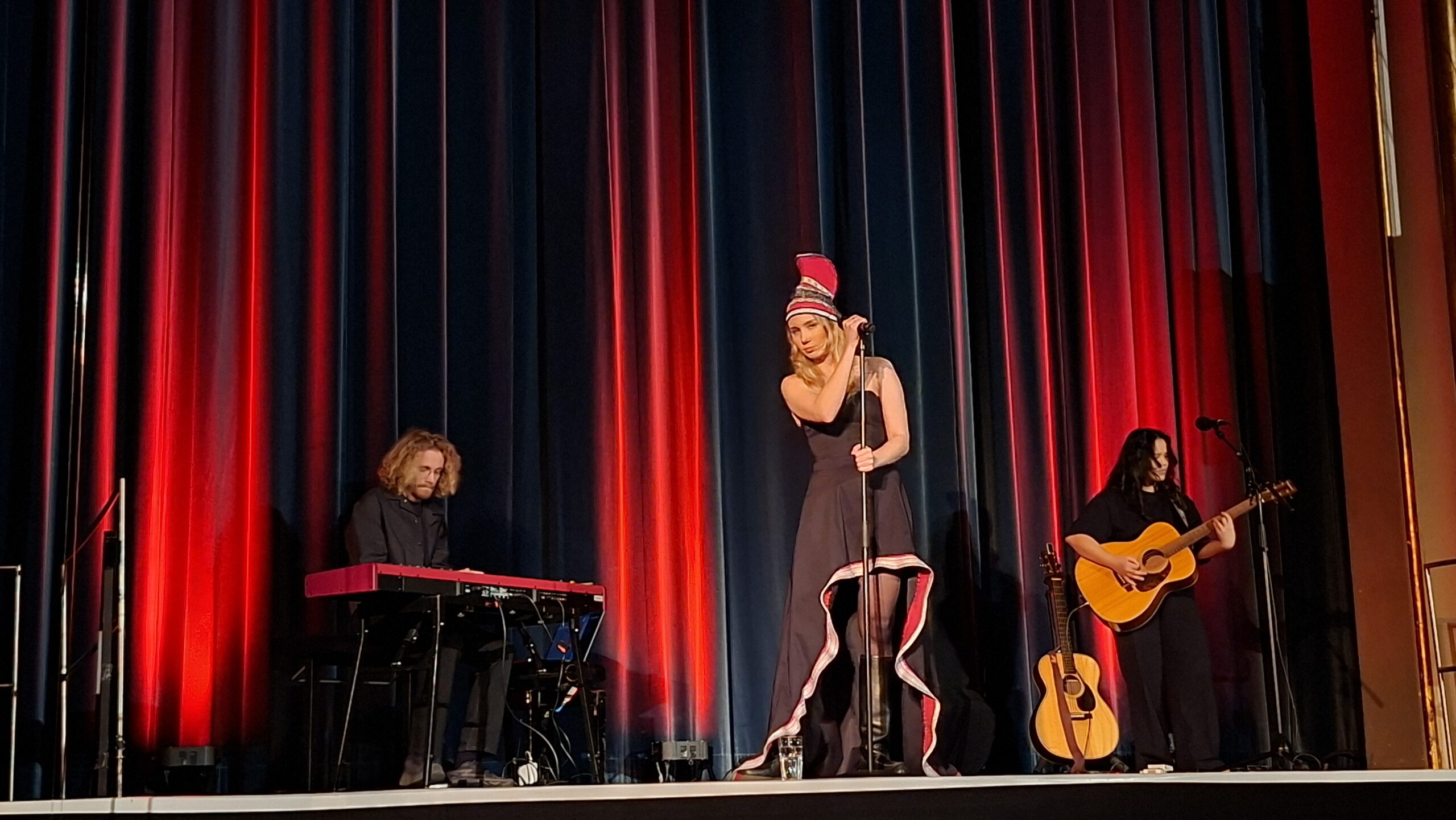
(Scroll down for artist bio) Sámi–Norwegian artist Ella Marie moves between modern pop, Northern Sámi language and joik, carrying that sound into a solo era shaped by her debut album Varra and the wider public visibility that came with the movie Let the River Flow. Speaking in Berlin at Babylon’s cinema setting, where the film screening ends and a concert begins, she frames the night as one continuous space for story, feeling and solidarity. In interview Ella Marie tells more.

The unusual format puts her in front of the audience in multiple ways, first as a presence introducing the screening, then as the lead actor on the screen and finally as solo artist on stage. She describes approaching that transition carefully, giving people room to sit with whatever rises during the end credits, while also trusting music as a way to land after a very emotional cinema experience. For her, the concert can hold what the film opens up, creating a place where reactions are not rushed into explanation.

That continuity is also how she understands her work in general. Whether she is making music, acting in a film, or showing up in activism, she returns to the same intention, pushing listeners and viewers toward empathy, particularly for vulnerable groups and minorities who have historically been unheard or reduced to symbols. The mediums change, but the mission does not and she talks about it less as switching roles than as using different tools toward the same end.

Her performance in Let the River Flow, playing Ester, came with a long preparation that she describes as both practical and personal. A key challenge was learning to inhabit shame as something lived, not abstract and to understand how people can be made to feel they should hide where they come from. She contrasts her own upbringing, where pride in Sámi heritage was passed down as a gift, with the reality that earlier generations carried heavier burdens of assimilation and silence.

Research became part of that process. She speaks about in-depth conversations with people involved in the Alta demonstrations of the 1970s and 1980s, including those connected to hunger strikes and how listening to their stories and trauma stays with her beyond the film itself. It also sharpened her sense of responsibility, to make Ester feel like a full human being rather than a stand-in for history.

She hopes the audience hears her music differently after seeing the film, not as a separate set but as another chapter in the same struggle. She points to the way the film’s story continues into present-day reality, describing how the public conversation around a sequel has effectively been answered by ongoing Sámi resistance in Norway. For her, that overlap has been emotional, not only because it confirms how much remains unresolved, but because it keeps the past from being safely contained as a period piece.

Her debut album Varra sits inside that present tense. She talks about songs beginning from different entrances, a joik impulse, a lyrical line, a melody, or a strong feeling that has to be shaped into form and about the album holding both direct political frustration and the private cost of living in constant confrontation. One thread is what it does to a person to feel they must repeatedly argue for their own worth, and how the pressure of public conflict can reshape a life from the inside.

Language is central to how she builds those songs. Ella Marie describes Northern Sámi as the language of her heart, with a sense of truth that does not translate cleanly into Norwegian or English. Writing in an endangered language also carries another layer of meaning, documenting it in music, keeping it present and letting it live forward rather than only surviving as a marker of loss. At the same time, she acknowledges the difficulty of translation, not only in vocabulary, but in perspective in who the lyrics address and in the emotional weight carried by small pronoun choices.

When she points to specific songs, the stories sharpen. She describes Sániid as a starting point for the album, often framed publicly as a song for her younger sister, but also written with her aunts and uncles in mind. Family members who were taken into boarding-school systems where Sámi language was forbidden. In her telling, the song becomes a kind of time travel, moving between her sister’s 2023 arrest during the Fosen protests and earlier generations’ experience of being surrounded by language that “isn’t ours,” with comfort offered across both timelines.

Gii Gielista carries a different energy. She recalls a court setting connected to demonstrations, watching official testimony unfold in a way that felt openly dishonest and receiving a message from her aunt that cut through the frustration with a line she immediately recognized as lyrics: “he lies so badly that the devil starts dancing.” The song became an ironic diss track and she describes humor not as a diversion from seriousness but as something necessary to endure it.

She also mentions Mannat as one of the songs she feels most proud of, partly because its meaning arrived after it was written. The track begins in homesickness, then turns toward a harder acceptance, there is no single place where she is fully safe from hate, including the kind that can emerge inside a pressured minority community. She describes the unsettling experience of realizing her subconscious had been that honest and the way a finished song can sometimes reveal what the writer was not ready to say directly.

Across music, acting and activism, she is clear on that balance is not guaranteed. What remains consistent is the hope that art can reach people who would not otherwise listen, working through feeling rather than argument. She talks about wanting change not as a slogan but as a future condition, so she can grow old and so children and grandchildren can live with more peace and pride than her generation has been allowed.

Ella Marie interview 15.01.2026
Producer: Janne Vuorela
https://www.instagram.com/ellamariehi
Picture: Janne Vuorela
An Analytical Biography of Ella Marie Hætta Isaksen’s Artistic and Activist Trajectory

The emergence of Ella Marie Hætta Isaksen as a central figure in the Nordic cultural and political landscape signifies a profound shift in the visibility and agency of the Sámi people within the modern nation-state of Norway. Born on April 25, 1998, in Deatnu (Tana), located in the Finnmark region, Isaksen has cultivated a career that serves as a bridge between the ancestral traditions of the Arctic north and the contemporary demands of global electronic music and Indigenous rights advocacy.1 Her trajectory is not merely a sequence of professional successes but a strategic deployment of artistic medium and public platform to challenge the historical residues of “Norwegianification” (fornorsking) and the contemporary pressures of “green colonialism”.3 To understand Isaksen is to engage with the resurgence of Sámi identity—a movement characterized by linguistic pride, environmental stewardship, and the reclamation of cultural space through music, cinema, and literature.

The Cultural and Geographic Matrix of Tana

Isaksen’s foundational identity is rooted in the municipality of Tana, a vital center for the Northern Sámi language and culture. Coming from a family deeply embedded in the traditions of reindeer herding, her early life was dictated by the rhythms of the land and the socio-economic structures of the Sámi people.2 The Sámi, whose ancestral lands—Sápmi—span across Norway, Sweden, Finland, and Russia, have historically navigated a complex relationship with the Norwegian state, marked by centuries of forced assimilation and the suppression of their native tongue.2 In Tana, the Northern Sámi language remained a living vessel of identity, and for Isaksen, it became the primary medium of her creative and political expression.1

This environment fostered an early understanding of the intersection between culture and survival. The traditions of coastal fishing, fur trapping, and sheep herding, alongside semi-nomadic reindeer herding, are not merely economic activities for the Sámi but are central to a worldview that prioritizes ecological balance.2 Isaksen’s early activism was a natural extension of this background. By the age of 17, she had already assumed a leadership role within the environmental organization Natur og Ungdom (Nature and Youth), serving as the county leader for Finnmark from early 2015 to early 2016.1 This period marked her transition from a private observer of cultural heritage to a public defender of Indigenous lands, a role that would eventually define her national profile.

The linguistic and cultural specificities of her upbringing provided the technical and emotional vocabulary for her musical career. In 2016, she gained initial recognition by winning the Sámi Grand Prix with her original composition, “Luoddaearru”.1 This victory was not only a personal milestone but also a demonstration of her ability to modernize the joik—a traditional form of Sámi vocal expression—while retaining its spiritual and rhythmic core. The success of “Luoddaearru” led her to the international stage, where she won the Liet International song competition in 2017, a prestigious event dedicated to minority and endangered languages.1 These early accolades established Isaksen as a vanguard of a new Sámi generation, one that refused to relegate its culture to the past.

Table 1: Foundational Biographical and Career Chronology
Date / PeriodLandmark EventInstitutional / Geographic Context
April 25, 1998Birth of Ella Marie Hætta IsaksenTana, Finnmark, Norway 1
2015 – 2016County Leader, Natur og UngdomFinnmark Region, Norway 1
Easter 2016Winner, Sámi Grand PrixKautokeino (Guovdageaidnu) 7
2017Winner, Liet InternationalInternational Minority Language Competition 1
Autumn 2017Campaign Secretary, Natur og UngdomNational Environmental Advocacy 1
January 2018Election to Central Board, Natur og UngdomNational Leadership Role 1
The ISÁK Era: Redefining the Modern Joik

In 2017, Isaksen co-founded the band ISÁK, a project that would revolutionize the perception of Sámi music in the 21st century. Collaborating with producer Daniel Eriksen and drummer Aleksander Kostopoulos, she sought to merge the ancient art of joik with the textures of modern synth-pop and electronic dance music.2 ISÁK was quickly recognized as the spiritual and musical successor to the legendary Mari Boine, who had pioneered the modernization of joik in the 1980s.2 However, ISÁK pushed this evolution further, utilizing urban synths and a bilingual lyrical approach that seamlessly integrated Northern Sámi and English.2

The philosophy of ISÁK was built on the idea of “Yoiking the Future,” a concept that utilized technology to amplify rather than dilute Indigenous identity.2 Their debut album, Ealán (2019), and the subsequent Roasut (2021) were critical in establishing “electronic-joik” as a viable mainstream genre.2 Isaksen’s vocals, characterized by their haunting clarity and rhythmic complexity, became a vehicle for expressing the duality of contemporary Sámi life—living within a modern, technologically advanced society while maintaining a profound connection to the spirits and stories of the land.2

The band’s international reach was significantly bolstered by high-profile collaborations with global electronic artists. Their work with Alan Walker and Steve Aoki on tracks like “Are You Lonely” and “Lonely” introduced Isaksen’s voice to millions of listeners worldwide.12 These collaborations were more than commercial ventures; they were acts of cultural diplomacy that asserted the relevance of the Sámi language in the global pop consciousness. Despite their immense success and a grueling international touring schedule, ISÁK announced their dissolution in May 2023.1 Their final performance at the Rockefeller Music Hall in September 2023 was described as a poignant farewell to an era that had fundamentally changed the Nordic music industry.2

Table 2: ISÁK Discography and Major Musical Releases
YearTitleFormatKey Details / Collaborations
2018“Elle”SingleEarly electronic-joik exploration 11
2019EalánAlbumDebut LP; Little Big Music 11
2019“Are You Lonely”SingleFeaturing Alan Walker & Steve Aoki 11
2020“u9k”MiscellaneousCollaborative project inclusion 13
2021RoasutAlbumSecond studio LP; thematic focus on climate 11
2021“Sorry”SingleCollaboration with Alan Walker 12
2023Live at The Norwegian OperaAlbumFinal major release as a group 11
National Breakthrough: Stjernekamp and the Politics of Representation

A pivotal moment in Isaksen’s career occurred in 2018 when she participated in the seventh season of Stjernekamp (Battle of the Stars), a prime-time television competition on the Norwegian public broadcaster NRK.1 Stjernekamp requires established artists to perform in a different musical genre each week, ranging from opera and country to hip-hop and blues. Isaksen’s victory in the competition was a watershed moment for Sámi representation in Norwegian media.9

Her performances in genres like blues (“Further On Up The Road”) and soul (“Stay With Me”) demonstrated a technical versatility that silenced critics who had previously pigeonholed her as a purely “ethnic” artist.15 However, her most impactful contribution was the consistent integration of joik and the Sámi language into the program’s mainstream format. By winning the competition with a finale that featured joik, she forced a national conversation about the historical exclusion of Sámi culture from Norwegian public life.3 For many young Sámi, her victory was a moment of profound validation, transforming her into a national “youth idol” and a symbol of a modern, unapologetic Indigenous identity.6

Isaksen’s success on Stjernekamp provided her with a massive public platform, which she immediately began to use for political purposes. She was no longer just a musician; she was a national figure whose presence challenged the comfortable narratives of Norwegian multiculturalism. Her victory suggested that the “Norwegianization” project had failed to extinguish the Sámi spirit and that the new generation was ready to lead on its own terms.3

The Fosen Conflict: Indigenous Rights and the Rule of Law

The most defining and high-stakes chapter of Isaksen’s activism centered on the Fosen Peninsula in central Norway. The conflict began in earnest after the Norwegian Supreme Court ruled on October 11, 2021, that the construction of two massive wind turbine parks—Roan and Storheia—on the Fosen Peninsula was unlawful.19 The court found that these wind farms, comprising 151 turbines, had been built on traditional winter grazing lands used by Sámi reindeer herders for centuries.21 This encroachment was deemed a direct violation of Article 27 of the International Covenant on Civil and Political Rights (ICCPR), which protects the rights of ethnic and linguistic minorities to enjoy their own culture.4

Despite the Supreme Court’s unanimous verdict, the Norwegian government took no immediate action to dismantle the turbines or restore the land. This period of legislative paralysis, which lasted over 500 days, became a symbol of the state’s disregard for Indigenous rights and the rule of law.19 Isaksen emerged as a primary leader of the protest movement, articulating a third-order insight: that the government’s inaction was a contemporary manifestation of the same colonial mindset that had driven the “Norwegianification” policies of the previous century.8

In February 2023, Isaksen and a group of young Sámi activists and environmentalists, including Greta Thunberg, launched a series of civil disobedience actions in Oslo.8 They occupied the Ministry of Petroleum and Energy for four days and subsequently blocked the entrances to multiple government ministries, effectively halting the administrative machinery of the state.19 The imagery of the protests was deeply symbolic; many activists, including Isaksen, wore their traditional gákti inside out.4 This act was a visceral protest against a state that they argued had “turned its back” on its own highest court and its Indigenous citizens.4

The intensity of the protests finally forced a response. On March 2, 2023, Prime Minister Jonas Gahr Støre issued an official apology for the ongoing human rights violations against the Fosen Sámi.20 However, the apology did not lead to the immediate removal of the turbines. Isaksen’s leadership during this period was recognized with the Fritt Ord Foundation Tribute in March 2023, which cited her “invaluable activities in the service of free speech” and her ability to merge art with activism to protect minority rights.8

Table 3: Chronology of the Fosen Human Rights Crisis and Civil Disobedience
DateEventOutcome / Legal Significance
October 11, 2021Supreme Court VerdictRuling that wind farms violate Sámi rights under Art. 27 ICCPR 19
February 23, 2023Start of Ministry Occupation4-day occupation of the Ministry of Petroleum and Energy 17
March 2, 2023Official State ApologyPM Jonas Gahr Støre admits to human rights violations 20
October 11, 2023“Lie-in” at StortingProtest inside the Norwegian Parliament on the verdict’s anniversary 21
January 19, 2024Charges Filed20 activists, including Isaksen, criminally charged for protests 21
March 11, 2024Trial BeginsOslo District Court trial for refusing to pay protest fines 24
June 27, 2025Final AcquittalSupreme Court acquits the activists, citing the necessity of protest 20

The legal repercussions of the protests were significant. In early 2024, Isaksen and 19 other activists were criminally charged after refusing to pay fines issued by the police during the ministry blockades.21 During the trial in March 2024, Isaksen delivered a searing testimony, stating, “It is absurd that those of us who defended our human rights are being punished, while those who broke them are not”.24 The legal battle concluded in June 2025, when the Supreme Court of Norway acquitted the activists, a landmark decision that affirmed the right to peaceful protest in the face of state-sponsored human rights violations.20

Cinematic and Literary Contributions: Recovering the Narrative

Isaksen’s influence extends into the realms of cinema and literature, where she has worked to dismantle the psychological structures of assimilation. In 2023, she made her screen debut as the lead actress in Ellos Eatnu – Let the River Flow (Northern Sámi: Ellos eatnu; Norwegian: La elva leve), directed by Ole Giæver.25 The film is set in 1979 and is inspired by the Alta conflict, a historical event involving a massive protest against the damming of the Alta-Kautokeino River.25 The parallels between the Alta conflict and the Fosen conflict were not lost on audiences, as Isaksen’s character, Ester, undergoes a journey from hiding her Sámi identity to becoming a frontline activist.25

The film served as a critical educational tool, bringing the history of Sámi resistance to a broad Nordic and international audience. Isaksen’s performance was widely lauded for its emotional depth and authenticity, earning her the Norwegian Film Critics Award for Best Actress in 2024.1 Beyond historical drama, she was the subject of the 2022 documentary Rahcan – Ella’s Rebellion, which offered an intimate look at her life as an environmental activist, particularly her efforts in the Repparfjord case where she fought against industrial mining waste being dumped into national salmon fjords.8

Her literary debut, Derfor må du vite at jeg er same (This is why you need to know that I am a Sámi), published in 2021, further solidified her role as a public intellectual.5 The book is a blend of personal memoir and political manifesto, detailing her struggle against discrimination and the internal shame (heahpu) often felt by Indigenous people who have been subjected to forced assimilation.3 Isaksen’s writing has been praised for its “unfiltered” honesty and its ability to act as an “ABC about Finnmark” for outsiders while serving as a “recognizable story for Sámi youth”.5

Table 4: Key Awards and Distinctions
YearAward / DistinctionAwarding Body / Category
2023Fritt Ord TributeFreedom of Expression Foundation 8
2023Nordic Pioneer PrizeLeadership and Social Change 14
2024Áillohaš Music PrizeKautokeino Municipality & Sámi Association 9
2024Film Critics AwardBest Actress (for Ellos Eatnu) 1
2024Zola PrizeCivil Courage and Human Rights 14
2024By:larmer of the YearNordic Music Industry Impact 14
2024Sámi of the Year (Nominee/Award)Ávvir / Cultural Recognition 29
Solo Career and the Future Trajectory (2024–2025)

Following the dissolution of ISÁK, Isaksen transitioned into a solo career that reflects a more personal and “timeless” pop sound, performed exclusively in Northern Sámi.3 Her solo work is characterized by its focus on resilience and unity, seeking to release the “painful feelings many indigenous people carry” through poetic and ground-breaking compositions.3 In 2024, she debuted this new solo direction at major festivals like Riddu Riđđu and Øyafestivalen, presenting a sound that is both musically sophisticated and politically charged.14

Her 2024 and 2025 output is marked by a series of singles that have continued to dominate the Sámi and Norwegian charts. Tracks such as “Mannat” and “Gii Gielista” (which received a high-profile remix from the duo Lemaitre) showcase her ability to balance artistic innovation with traditional joik.13 Her debut solo album, Varra (Blood), released on October 31, 2025, is a conceptual exploration of lineage, trauma, and the biological and spiritual connection to the land.30 The album’s title refers to both the “blood struggle” for land rights and the “bloodlines” that connect the current generation to their ancestors.30

As of early 2026, Isaksen is embarking on a comprehensive tour across Scandinavia with her band, featuring “powerful protest joik” and a focus on Sámi cultural heritage.14 Her career has reached a stage where her presence is required at both major music festivals and international human rights forums. In May 2024, she was a featured speaker at WEXFO (World Expression Forum), contributing to discussions on protecting artistic freedom in a complex landscape.3

Table 5: Solo Discography and Recent Singles (2024–2025)
Release DateTitleFormatTheme / Context
2024“Mannat”SingleBreakup and personal autonomy 13
2024“Gii Gielista”SingleDeception and cultural truth 13
2024“Sániid”SingleThe weight of words in Sámi 13
2024“Who Took You Away (Mu Áhkku)”SingleAncestral loss and grandmother’s legacy 13
2024“Lean Dás”Single / CollabWith Mari Boine; passing the torch 13
2025“Gumpe”SingleThe wolf as a symbol of the wild 13
2025“Mu Váibmu”Single“My Heart” – intimate vulnerability 30
2025“Oahpes Namat”SingleNames and the identity of the land 13
Oct 31, 2025VarraAlbumFull debut studio LP; 12 tracks 30
Synthesis: The Artist as Human Rights Defender

Ella Marie Hætta Isaksen’s career represents a rare synthesis of mainstream pop stardom and uncompromising Indigenous activism. She has effectively utilized the mechanisms of the Norwegian state—its television shows, its music festivals, and its courtrooms—to highlight the state’s own failures in its relationship with the Sámi people.22 This dual role has occasionally placed her in positions of extreme personal and professional risk, notably during the Fosen trials, where she faced potential imprisonment for her role in civil disobedience.21

The broader implications of her work suggest that for the modern Sámi artist, the aesthetic and the political are inseparable. Her music is not merely a “cultural product” but a “safe space” where the trauma of the past is confronted and the pride of the present is celebrated.3 By consistently performing in Northern Sámi, even at the height of her international fame with Alan Walker, she has asserted linguistic sovereignty in a way that few artists before her have achieved.12

Looking forward, Isaksen’s trajectory points toward an even more integrated approach to culture and policy. Her 2025 tour and album Varra signify a maturity that moves beyond the immediate urgency of the protest line toward a more profound, long-term exploration of what it means to be Indigenous in the 21st century.14 Her acquittal by the Supreme Court in June 2025 stands as a testament to her effectiveness as a human rights defender, proving that her voice is as powerful in the courtroom as it is on the stage.20 For the Sámi people and for the broader global Indigenous community, Ella Marie Hætta Isaksen remains a definitive figure of resistance, resilience, and creative renewal.

References
  1. Ella Marie Hætta Isaksen – Wikipedia  https://en.wikipedia.org/wiki/Ella_Marie_H%C3%A6tta_Isaksen
  2. Ella Marie Hætta Isaksen in ISÁK – Arctic music selections – Dartmouth Journeys  https://journeys.dartmouth.edu/coldregionsmusic24/2024/02/01/ella-marie-haetta-isaksen-in-isak/
  3. Ella Marie Hætta Isaksen – WEXFO  https://wexfo.no/artists/ella-marie-haetta-isaksen-2/
  4. Civil Disobedience on Trial: Indigenous Protest against Governmental Inaction  https://internationallawobserver.eu/civil-disobedience-on-trial-indigenous-protest-against-governmental-inaction
  5. Ella Marie Hætta Isaksen | Cappelen Damm https://www.cappelendamm.no/forfatter/ella-marie-haetta-isaksen-45333
  6. Ella Marie Hætta Isaksen – Nature and Youth – the nomad magazine  https://www.the-nomad-magazine.com/ella-marie-haetta-isaksen-nature-and-youth/
  7. Ella Marie Hætta Isaksen – Sámi Grand Prix 2016 – YouTube  https://www.youtube.com/watch?v=3tfX6iGodhA
  8. Freedom of Expression Foundation Tribute to Ella Marie Hætta …  https://frittord.no/en/news/freedom-of-expression-foundation-tribute-to-ella-marie-haetta-isaksen
  9. Ella Marie Hætta Isaksen wins music prize – The Norwegian American  https://www.norwegianamerican.com/ella-marie-haetta-isaksen-wins-music-prize/
  10. The Fritt Ord Tribute 2023: Ella Marie Hætta Isaksen https://frittord.no/en/prizes/the-freedom-of-expression-tribute/ella-marie-haetta-isaksen
  11. ISÁK Discography: Vinyl, CDs, & More – Discogs https://www.discogs.com/artist/6868431-IS%C3%81K
  12. Ella Marie Hætta Isaksen Songs – Gaana https://gaana.com/artist/ella-marie-htta-isaksen
  13. Ella Marie – TIDAL https://tidal.com/browse/artist/7153511
  14. ISFiT presents: Ella Marie // Skala – Samfundet.no https://www.samfundet.no/en/events/4195-isfit-presents-ella-marie-skala
  15. STJERNEKAMP 2018 – BLUES: Ella Marie Hætta Isaksen: Further On Up The Road  https://www.youtube.com/watch?v=N1zMsCEFUqg
  16. STJERNEKAMP 2018 – SOUL: Ella Marie Hætta Isaksen: Stay With Me – Jarle Bernhoft  https://www.youtube.com/watch?v=lzT67GuNwQ4
  17. Ella Marie Hætta Isaksen – Wikipedia  https://de.wikipedia.org/wiki/Ella_Marie_H%C3%A6tta_Isaksen
  18. ELLA MARIE (SÁ/NO) – Festspillene i Nord-Norge  https://festspillnn.no/en/2025/event/ella-marie-sano
  19. BAAJH VAERIDE ÅRRODH! LET THE MOUNTAINS LIVE! – Gupea  https://gupea.ub.gu.se/bitstreams/0e2516cc-7aed-4a20-a91c-dbf6f899a2b7/download
  20. Fosen – Wikipedia  https://en.wikipedia.org/wiki/Fosen
  21. Sami rights activists in Norway charged over protests against wind farm affecting reindeer herding – CityNews Halifax https://halifax.citynews.ca/2024/01/19/sami-rights-activists-in-norway-charged-over-protests-against-wind-farm-affecting-reindeer-herding/
  22. Norway activists renew protest against wind farm on land used by herders | AP News  https://apnews.com/article/norway-wind-turbine-sami-protest-4e793917265bd63a6bf319ffb7806107
  23. Norway arrests 20 Indigenous activists following protests against wind turbine operation  https://www.jurist.org/news/2024/01/norway-arrests-20-indigenous-activists-following-protests-against-wind-turbine-operation/
  24. Sami demonstrators called into court | Norway’s News in English — www.newsinenglish.no https://www.newsinenglish.no/2024/03/11/sami-demonstrators-called-into-court/
  25. Let the River Flow – Wikipedia  https://en.wikipedia.org/wiki/Let_the_River_Flow
  26. Ellos eatnu – Let the River Flow – Verdensteatret – Cinemateket i Tromsø  https://www.verdensteatret.no/movie/ellos-eatnu-la-elva-leve-1
  27. monday film: ELLOS EATNU – let the river flow (pre premiere) | Kosmorama (English)  https://kosmorama.no/en/events/mandagsfilmen-ellos-eatnu-la-elva-leve-f%C3%B8rpremiere-med-ettersnakk-med-regiss%C3%B8r-og-hovedrolle
  28. Rahčan – Ella’s Riot – Nordisk Panorama https://nordiskpanorama.com/en/rahcan-ellas-riot/
  29. Ella Marie Hætta Isaksen – Wikidata https://www.wikidata.org/wiki/Q29511633
  30. Ella Marie – Apple Music  https://music.apple.com/no/artist/ella-marie/1736746589
  31. Ella Marie Hætta Isaksen Discography: Vinyl, CDs, & More | Discogs https://www.discogs.com/artist/7007973-Ella-Marie-H%C3%A6tta-Isaksen
  32. Ella Marie – Mu Váibmu – Live at Korjaamo, Helsinki, Jan. 9, 2026 – YouTube  https://www.youtube.com/watch?v=4GJ8jSV0rSw