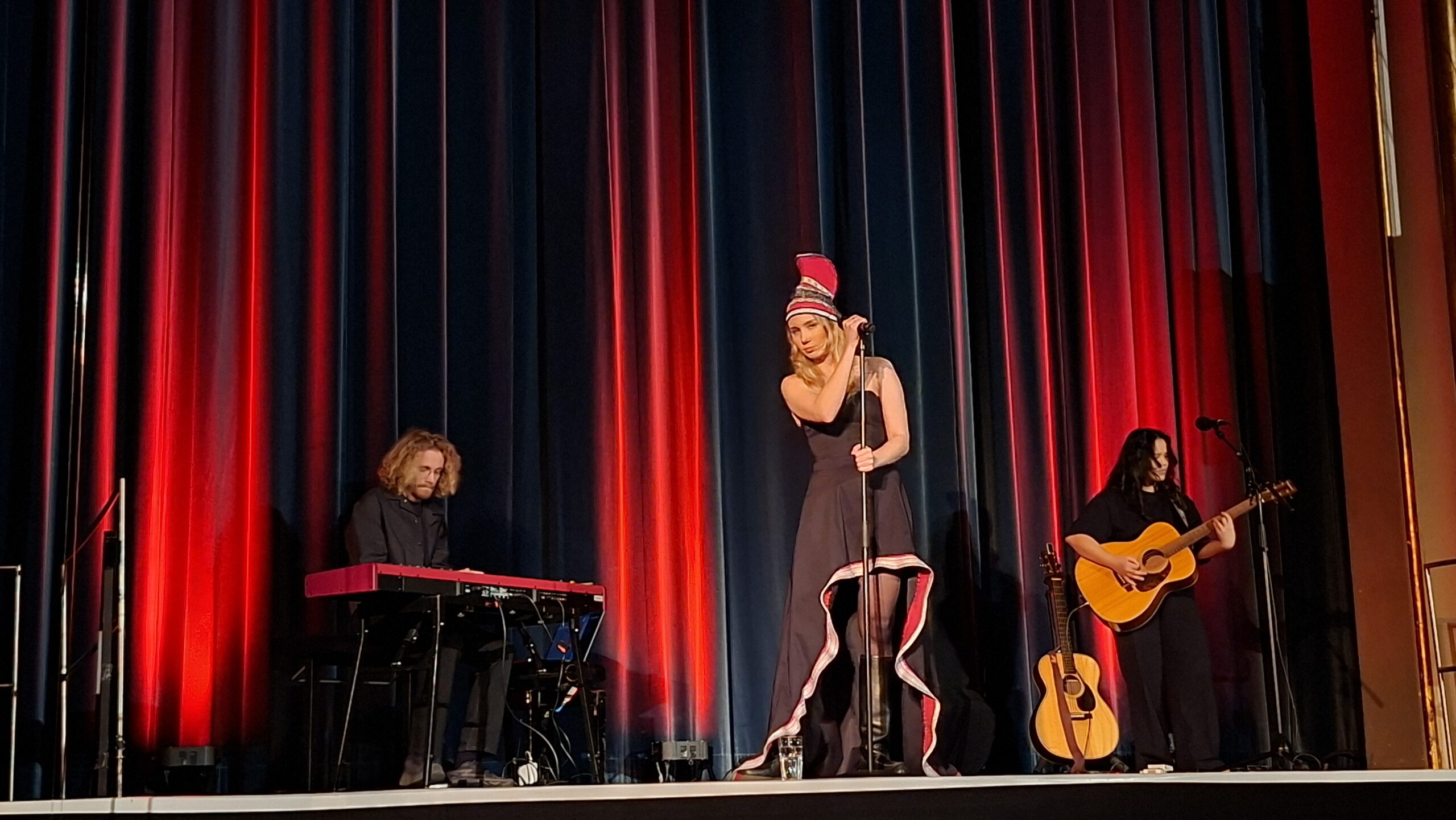
(Scroll down for artist bio) Sámi–Norwegian artist Ella Marie moves between modern pop, Northern Sámi language and joik, carrying that sound into a solo era shaped by her debut album Varra and the wider public visibility that came with the movie Let the River Flow. Speaking in Berlin at Babylon’s cinema setting, where the film screening ends and a concert begins, she frames the night as one continuous space for story, feeling and solidarity. In interview Ella Marie tells more.
The unusual format puts her in front of the audience in multiple ways, first as a presence introducing the screening, then as the lead actor on the screen and finally as solo artist on stage. She describes approaching that transition carefully, giving people room to sit with whatever rises during the end credits, while also trusting music as a way to land after a very emotional cinema experience. For her, the concert can hold what the film opens up, creating a place where reactions are not rushed into explanation.
That continuity is also how she understands her work in general. Whether she is making music, acting in a film, or showing up in activism, she returns to the same intention, pushing listeners and viewers toward empathy, particularly for vulnerable groups and minorities who have historically been unheard or reduced to symbols. The mediums change, but the mission does not and she talks about it less as switching roles than as using different tools toward the same end.
Her performance in Let the River Flow, playing Ester, came with a long preparation that she describes as both practical and personal. A key challenge was learning to inhabit shame as something lived, not abstract and to understand how people can be made to feel they should hide where they come from. She contrasts her own upbringing, where pride in Sámi heritage was passed down as a gift, with the reality that earlier generations carried heavier burdens of assimilation and silence.
Research became part of that process. She speaks about in-depth conversations with people involved in the Alta demonstrations of the 1970s and 1980s, including those connected to hunger strikes and how listening to their stories and trauma stays with her beyond the film itself. It also sharpened her sense of responsibility, to make Ester feel like a full human being rather than a stand-in for history.
She hopes the audience hears her music differently after seeing the film, not as a separate set but as another chapter in the same struggle. She points to the way the film’s story continues into present-day reality, describing how the public conversation around a sequel has effectively been answered by ongoing Sámi resistance in Norway. For her, that overlap has been emotional, not only because it confirms how much remains unresolved, but because it keeps the past from being safely contained as a period piece.
Her debut album Varra sits inside that present tense. She talks about songs beginning from different entrances, a joik impulse, a lyrical line, a melody, or a strong feeling that has to be shaped into form and about the album holding both direct political frustration and the private cost of living in constant confrontation. One thread is what it does to a person to feel they must repeatedly argue for their own worth, and how the pressure of public conflict can reshape a life from the inside.
Language is central to how she builds those songs. Ella Marie describes Northern Sámi as the language of her heart, with a sense of truth that does not translate cleanly into Norwegian or English. Writing in an endangered language also carries another layer of meaning, documenting it in music, keeping it present and letting it live forward rather than only surviving as a marker of loss. At the same time, she acknowledges the difficulty of translation, not only in vocabulary, but in perspective in who the lyrics address and in the emotional weight carried by small pronoun choices.
When she points to specific songs, the stories sharpen. She describes Sániid as a starting point for the album, often framed publicly as a song for her younger sister, but also written with her aunts and uncles in mind. Family members who were taken into boarding-school systems where Sámi language was forbidden. In her telling, the song becomes a kind of time travel, moving between her sister’s 2023 arrest during the Fosen protests and earlier generations’ experience of being surrounded by language that “isn’t ours,” with comfort offered across both timelines.
Gii Gielista carries a different energy. She recalls a court setting connected to demonstrations, watching official testimony unfold in a way that felt openly dishonest and receiving a message from her aunt that cut through the frustration with a line she immediately recognized as lyrics: “he lies so badly that the devil starts dancing.” The song became an ironic diss track and she describes humor not as a diversion from seriousness but as something necessary to endure it.
She also mentions Mannat as one of the songs she feels most proud of, partly because its meaning arrived after it was written. The track begins in homesickness, then turns toward a harder acceptance, there is no single place where she is fully safe from hate, including the kind that can emerge inside a pressured minority community. She describes the unsettling experience of realizing her subconscious had been that honest and the way a finished song can sometimes reveal what the writer was not ready to say directly.
Across music, acting and activism, she is clear on that balance is not guaranteed. What remains consistent is the hope that art can reach people who would not otherwise listen, working through feeling rather than argument. She talks about wanting change not as a slogan but as a future condition, so she can grow old and so children and grandchildren can live with more peace and pride than her generation has been allowed.
Ella Marie interview 15.01.2026
Producer: Janne Vuorela
https://www.instagram.com/ellamariehi
Picture: Janne Vuorela