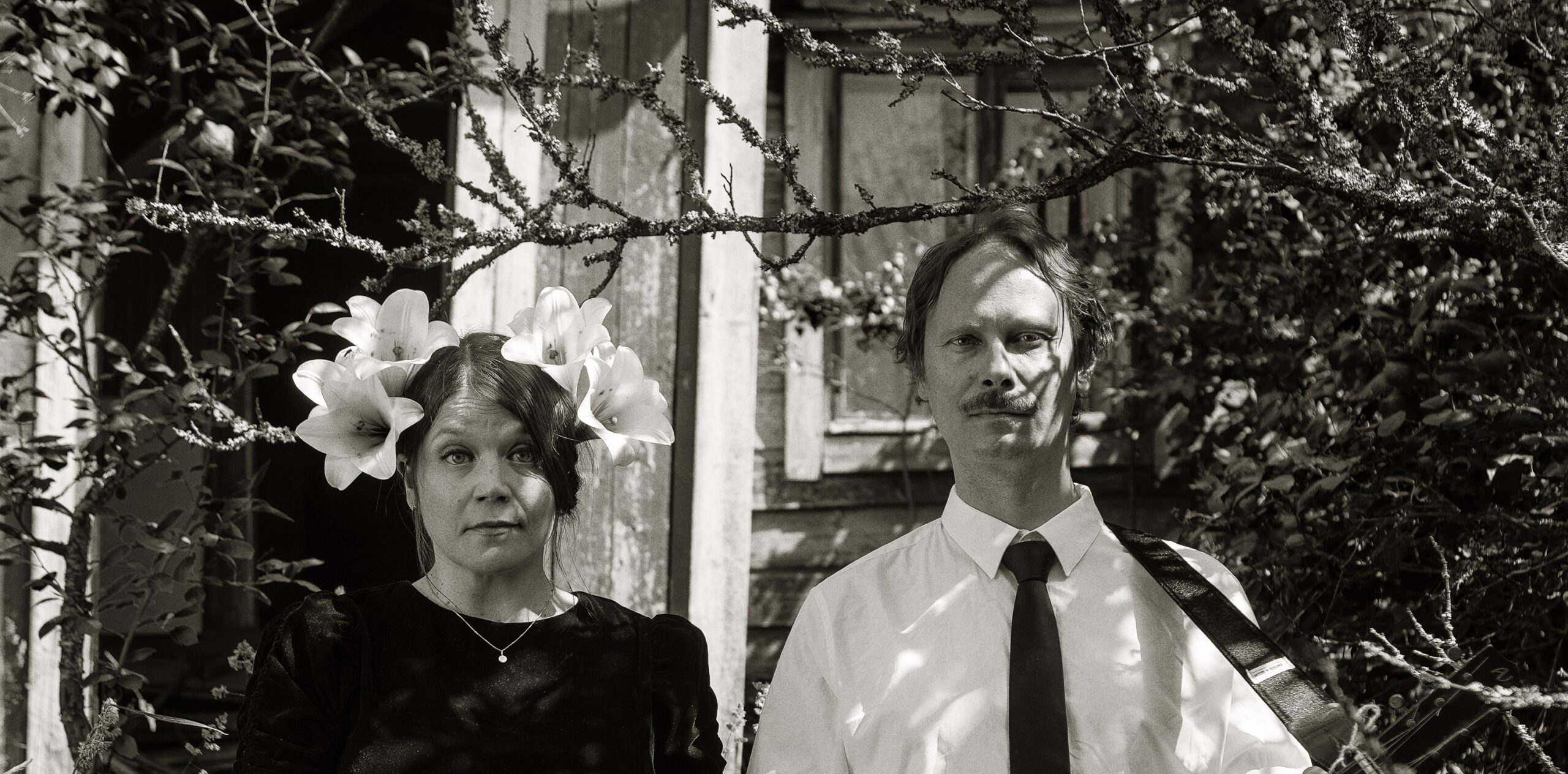
Finnish melancholic rock band Lasten Hautausmaa return with “Kesä,” a setting of Lauri Viita’s poetry created for Kaisa & Christoffer Leka’s Kohti vaaraa exhibition and paired with the Saima Harmaja-based “Heikko” on a forthcoming seven-inch. The songs bring the group’s familiar narrative melancholy into a wider project about mortality, limitation and the need to understand existence. In interview singer Kristiina Vaara and guitarist Tuomo Mannonen tell more.
For Vaara and Mannonen, the beginning still feels unusually immediate. They met after a Kivesveto Go Go show, agreed that evening to make music together and were in a Kouvola rehearsal room within weeks, essentially on the second time they had properly met.
Vaara already had lyrics and Mannonen a rough song, and “Iho, hiukset ja luut” appeared during those first sessions. More material followed quickly, recorded in the small studio attached to the rehearsal room and put on SoundCloud with a hurried, nearly dark photograph taken before Vaara had to catch her train.
The name arrived with the same lack of ceremony, taken from Aapeli Kissala’s “Lasten hautausmaa,” which the band has also covered. Mannonen remembers Svart Records making contact while the group was still thinking about a self-release, before there was much time to decide what the project was supposed to become.
That answer came through live shows. Inquiries began arriving soon after the SoundCloud songs, the five-song EP appeared in 2014 and a full-length followed in 2015, with the response around the album making it clear that Lasten Hautausmaa had moved beyond a one-off collaboration.
That early momentum also explains why II followed in under a year. Vaara describes an initial euphoria where everyone made the band a priority, rehearsing weekly, carrying riffs from soundchecks into new songs and writing lyrics in the back of the tour van between shows.
By III, the process had started to open. A bassist change brought Topi Teinilä into the group, and recording moved from the rehearsal room to a village school, where an outside engineer handled the sessions and the band found a slightly more deliberate working frame.
The location suited them because it removed distractions. They recorded, grilled and slept at the same building, but the schedule was still characteristically tight: Vaara, then living in Germany, sang the whole record on the final day while the others were already moving equipment around her before her flight.
Band’s fourth album IV kept some of that retreat feeling. The band hears the musical palette widening through those records, rather than changing through one single break.
When Vaara looks at the five albums now, she does not hear the fifth album Kevät as an isolated rupture so much as part of a wider change that began around III and continued through IV. The first EP and two albums belong closer together in her mind, while the later records carry a broader palette even when the basic working method remains recognizable.
Kevät did have a practical difference. Vaara had moved to Kouvola, which gave her and Mannonen more time in the same room and allowed the full band to rehearse, arrange and write together more than before, the songs also formed one story taking place across a single spring.
The pandemic left one small marker inside that story. They remember discussing whether “Pilvipoutaa” should include a cloth-mask detail as a precise piece of its time, one of the moments where their mutual veto over words became part of deciding how specific or timeless a song should feel.
What remains across every period is harder for them to name than to recognize. Vaara lands on small-scale storytelling, melancholy and wistfulness, while Mannonen points to the freedom around that center: the music can move from folk toward something much heavier without losing its identity.
That melancholy is not meant to end in defeat. Vaara says she would dislike the songs leaving only a crushed or hopeless feeling, the aim is closer to sadness that still lifts the listener slightly, as Tuomo puts it, ten centimeters above the ground.
The route into “Kesä” began as personally as the band itself. After a show, a man handed Vaara and Mannonen a wrapped package containing a letter, which they briefly forgot among their gear before discovering an invitation from Kaisa and Christoffer Leka.
The artists had followed Lasten Hautausmaa and asked the band to respond musically to a photographic exhibition they had been developing for years. “Kohti vaaraa” brings several artistic voices around questions of finitude, suffering and consciousness, while Lasten Hautausmaa chose two photographs and answered them with songs.
One image, with an old house and a flowering slope, immediately brought Mannonen back to Lauri Viita’s “Onni.” The poem had stayed with him for years, especially its images of an overgrown path, an abandoned house and a summer continuing after a person is gone, and the photograph finally gave him a reason to set part of it to music.
The poem’s history added another layer. “Onni” appeared in Parnasso on the day after Viita died from injuries sustained in a car accident in December 1965, leaving its summer imagery permanently close to loss and continuation.
Once “Kesä” established the literary frame, the group decided the second song should remain inside Finnish poetry. “Heikko,” built from a Saima Harmaja text and another exhibition photograph, became a companion piece rather than a simple leftover B-side.
Although the exhibition opening will feature Lasten Hautausmaa Duo because of the space, Vaara and Mannonen stress that both songs were made by the full band. Svart Records will release the 350-copy seven-inch on October 2, with the Porvoo opening following at Näsin kartano on October 3.
The next full-length is already beginning to take shape after the four-year gap from Kevät. The band considered bringing in an outside producer, but production thinking has increasingly developed from inside the group, and they can already hear that changing the material before the songs are complete.
They are careful not to describe the direction too firmly. The same wistfullness is still there, but there are different edges around it and at least one piece Mannonen describes as almost punk, which brings the familiar question of how far a band can move while still sounding like itself.
After the autumn shows, the main plan is to turn toward recording, with much of January kept open for that work rather than live activity. They make no fixed promise about timing, but the material is already far enough along that the next chapter is no longer only an idea.
Lasten Hautausmaa interview 20.08.2026
Kristiina Vaara & Tuomo Mannonen
Producer: Janne Vuorela
https://www.instagram.com/lastenhautausmaa/
Picture: Miikka Pihlajamäki / Lasten Hautausmaa